Accounting Primer
Double-entry accounting for developers who have never touched a ledger before.
If you've never worked on a financial system, the vocabulary is the hard part. "Debit" and "credit" don't mean what they mean at an ATM. "Liability" sounds bad but describes a customer's wallet balance. This page fixes that before you touch any code.
You do not need an accounting degree to use Shiwake. You need about fifteen minutes and the five or six ideas below.
The payoff for learning this: you can never quietly lose track of money. Every movement is recorded twice, and the two halves are forced to agree. When they don't, the system refuses the write instead of silently drifting. That guarantee is the whole reason double-entry has outlived every accounting fad for 500 years.
The mental model
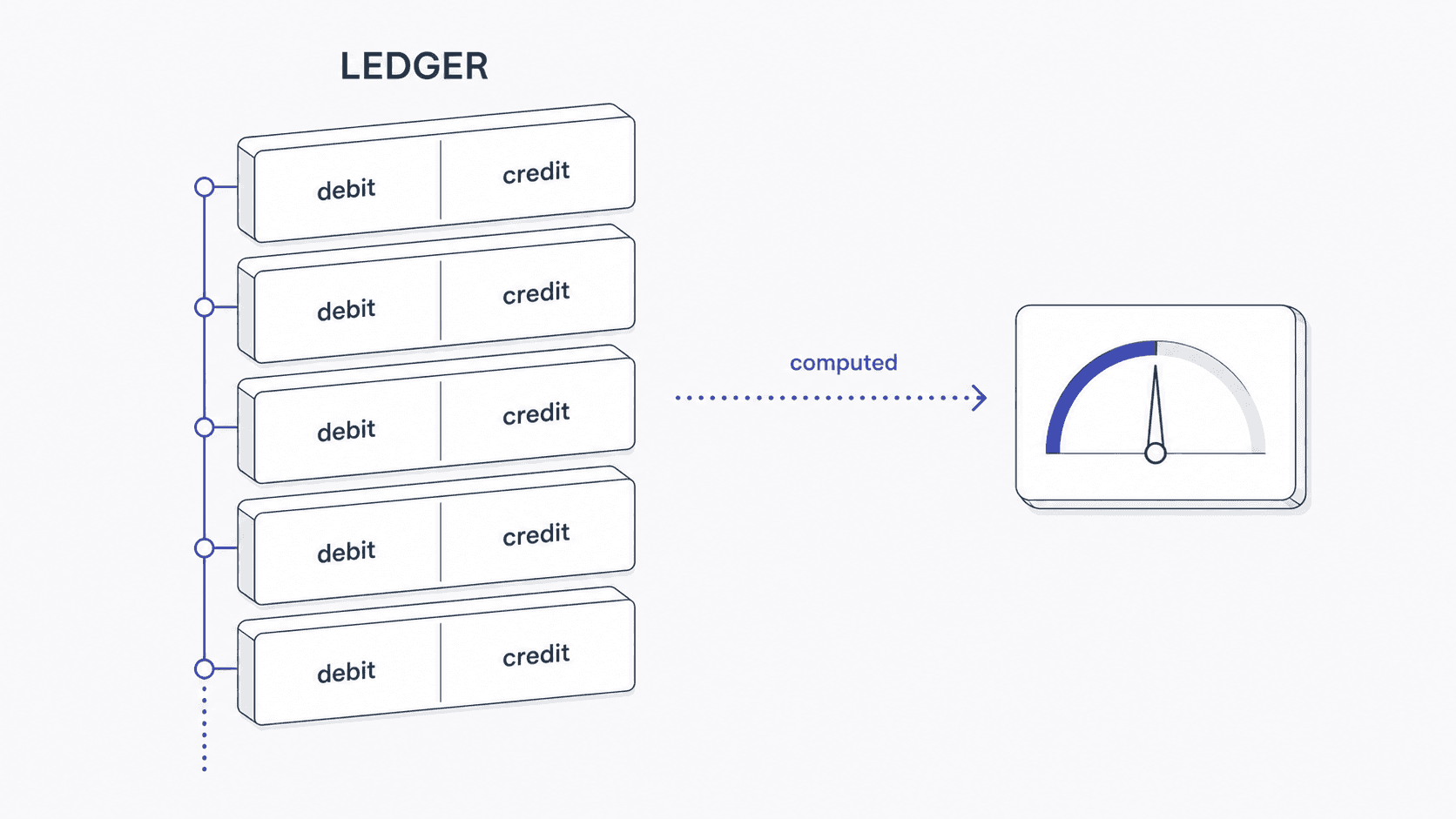
A ledger is a list of facts about money that has already moved. It is not a bank account, not a balance, not a wallet. It is a log. Balances are computed from the log, not stored as the source of truth.
Every fact in the log must explain both sides of a money movement: where it came from and where it went. That's the whole idea behind double-entry. You cannot record "money appeared" without also recording "money disappeared from somewhere else."
If money always moves from somewhere to somewhere, the total amount "from" and the total amount "to" must be equal. That is the only rule of double-entry. Everything else is terminology for that rule.
The core terms
Account
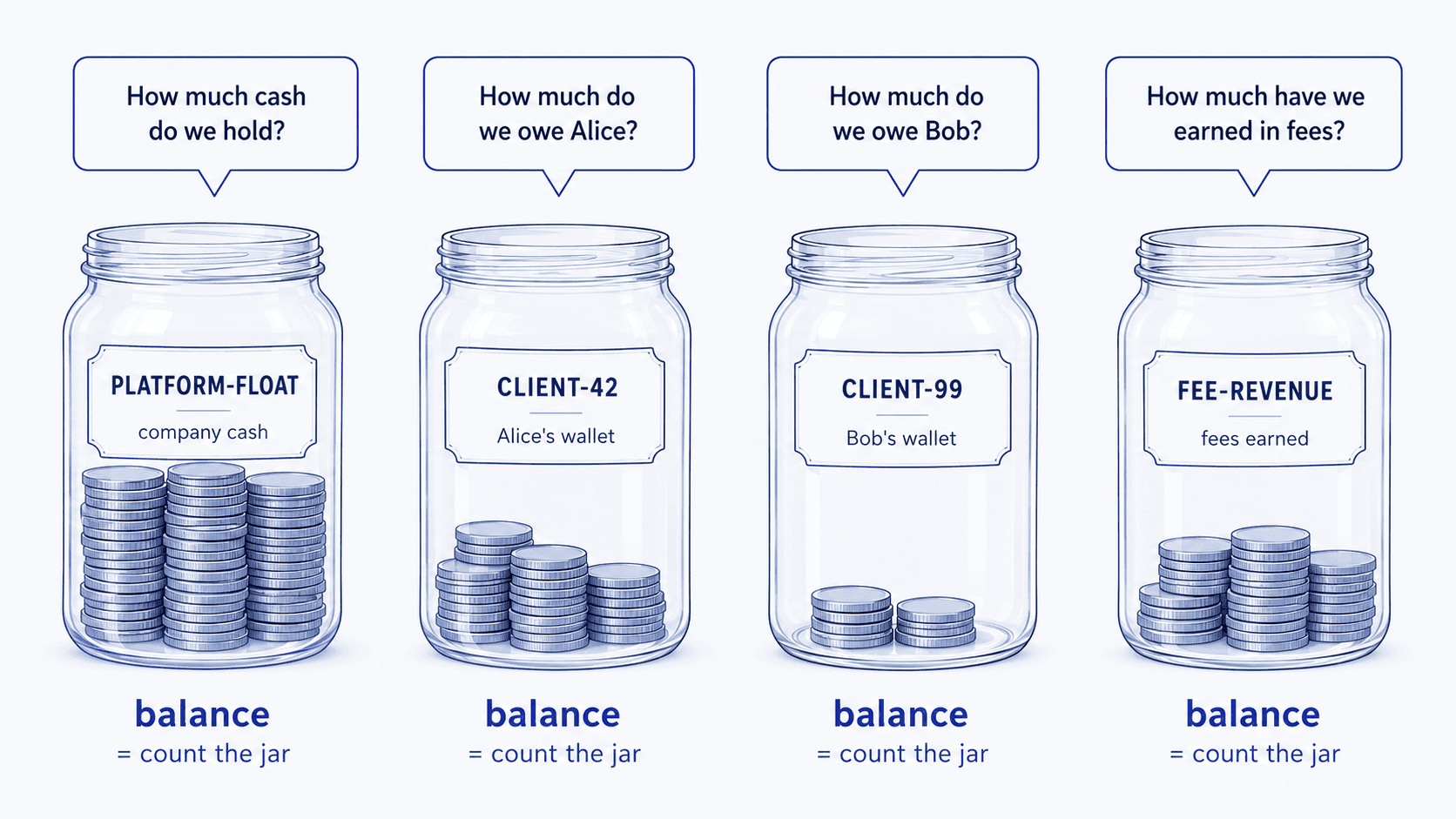
An account is just a label you stick on money so you can ask "how much is here?" and get one number back. Nothing more.
The trick is: you make a separate account for every question you want to answer separately.
- "How much cash does the company hold right now?" → make an account for
that. Call it
PLATFORM-FLOAT. - "How much do we owe Alice?" → make an account for that:
CLIENT-42. - "How much do we owe Bob?" → that's a different question, so it's
a different account:
CLIENT-99. - "How much have we earned in fees this whole time?" → another account:
FEE-REVENUE.
That's why a real product has thousands of accounts: one for the company's cash, one per customer wallet, one for fees, one for taxes owed, and so on. Each one just answers its own "how much?" question.
The word "account" is unfortunate: forget your bank account. A better mental image is a labeled jar. Money movements drop coins into jars or take them out, and the account is simply the running count in one jar. You never store that count; you get it by counting the jar (summing the log) whenever someone asks.
In Shiwake, every account has just four things:
- a code: the unique handle you refer to it by, like
CLIENT-42 - a name: a human label, like "Alice's wallet"
- a type: one of the five kinds below (Asset, Liability, …), which decides whether debits grow it or shrink it
- a currency: an account only ever holds one currency
Journal entry
A journal entry is one complete story of a single money movement. "Alice deposited 500" is one journal entry. "We paid out a refund of 200" is another. Each entry is one row in the log, and it never gets edited or deleted once written.
But a story needs at least two characters, where the money came from and where it went to. So an entry isn't just one number; it's a small container holding:
- a description ("Alice deposit") and a timestamp, and
- two or more lines: the actual pieces that say which jars moved.
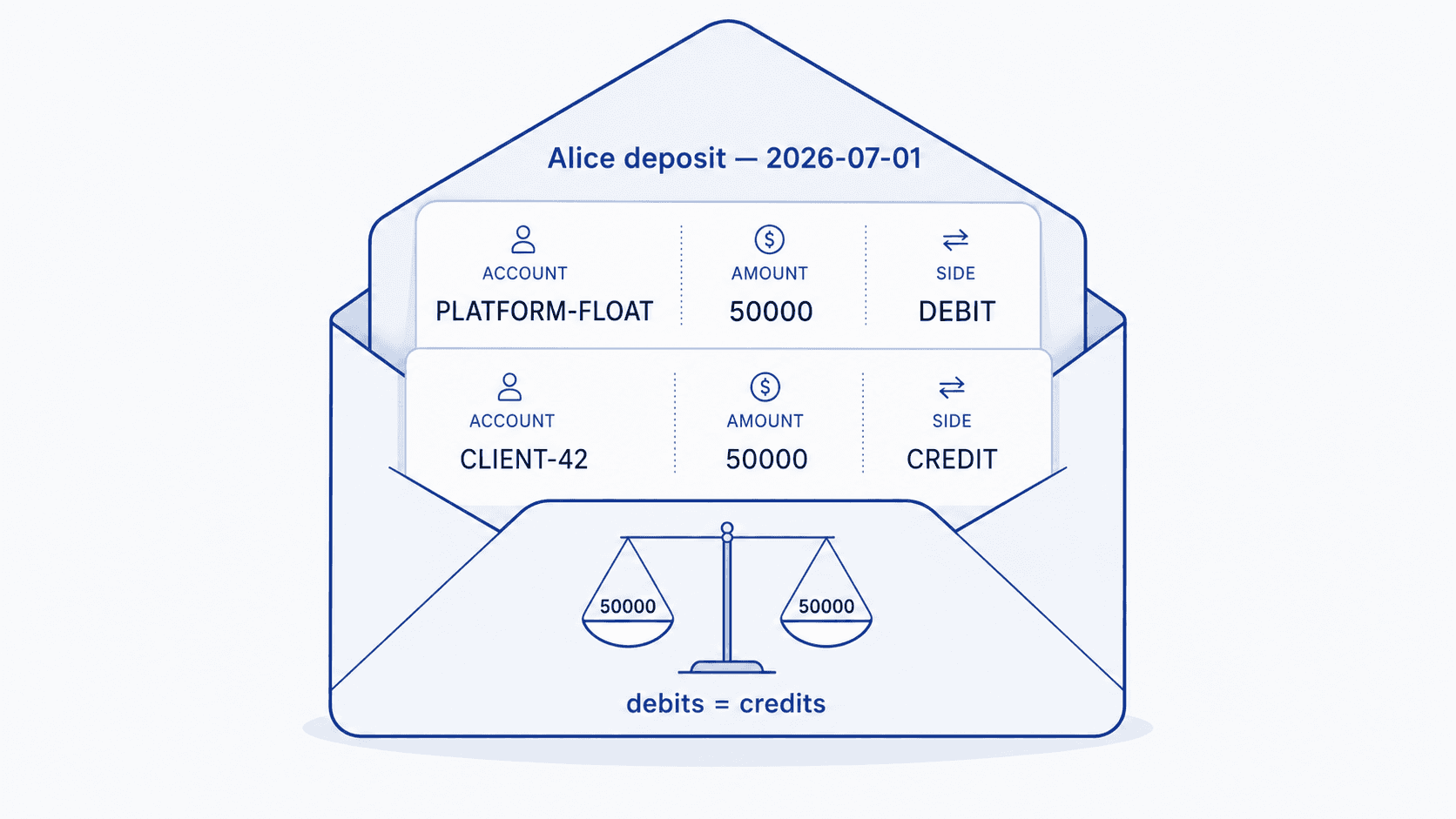
Think of the entry as an envelope and the lines as the slips of paper inside it. The envelope is the event; the slips are the details. You always post the whole envelope at once, never a lone slip.
Entry line
A line is one slip inside the envelope. It says exactly three things:
- which account moved (
CLIENT-42), - how much (50000), and
- which side: a debit or a credit.
That's it. One line touches exactly one account. A minimum entry has two lines (one debit, one credit: the "from" and the "to"). Bigger entries can have more: splitting a payment into principal + fee + tax might have four or five lines. The only unbreakable rule is that, added up, the debit lines and the credit lines must total the same amount. That's what "the envelope balances" means.
Debit and credit
Here is the sentence to tattoo on your brain:
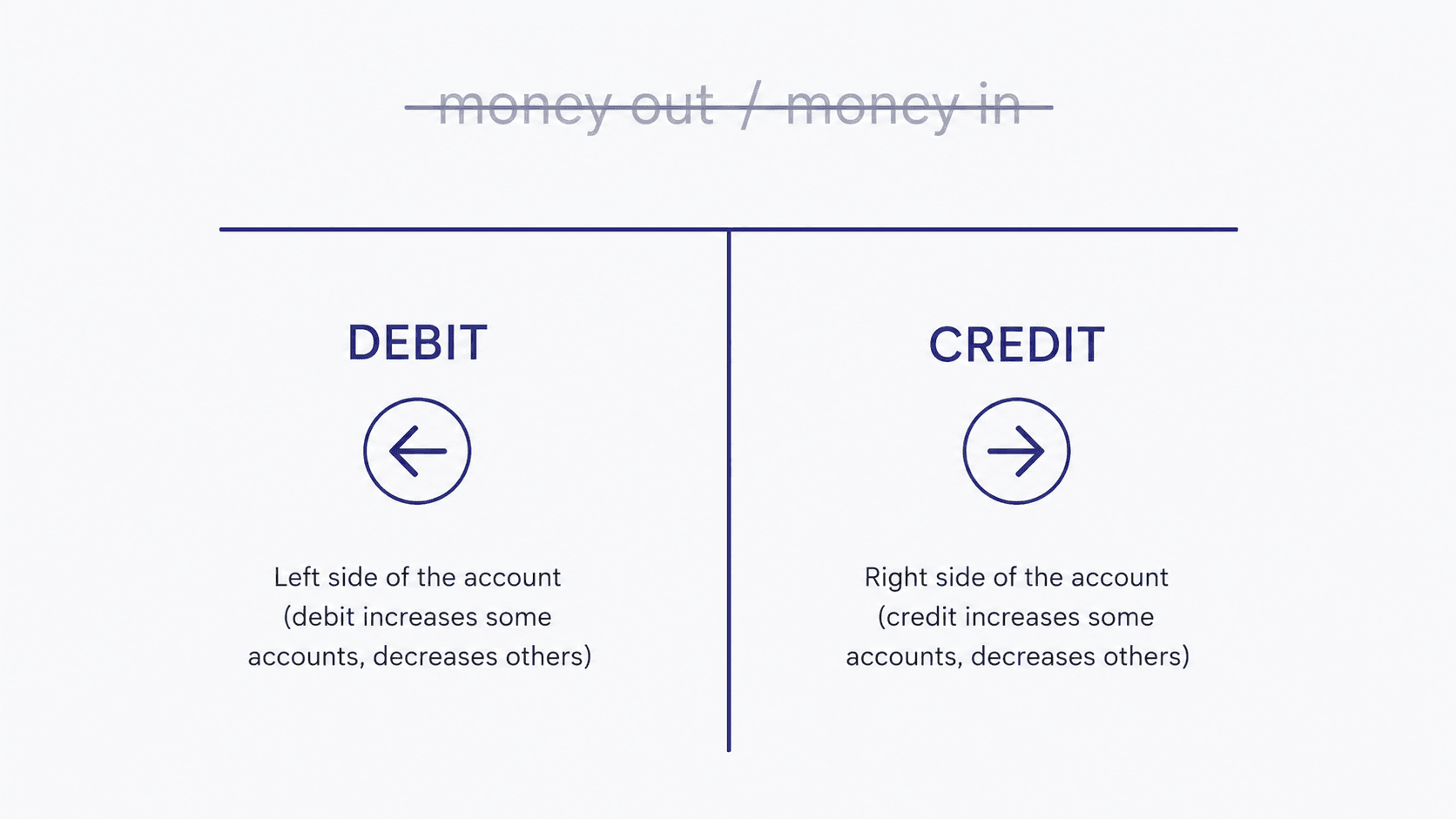
Debit and credit are just "left side" and "right side" of the ledger. They are not "money in" and "money out."
Whether a debit means "the account grew" or "the account shrank" depends on the type of account. That's what "normal balance" means below.
Forget everything your bank statement taught you. In a bank statement, a "debit" takes money from you, because the statement is written from your perspective, but to the bank, that same transaction is a credit (their liability to you went down). Double-entry keeps one side in one column and the other side in the other, consistently, across the entire ledger.
Account types and normal balances
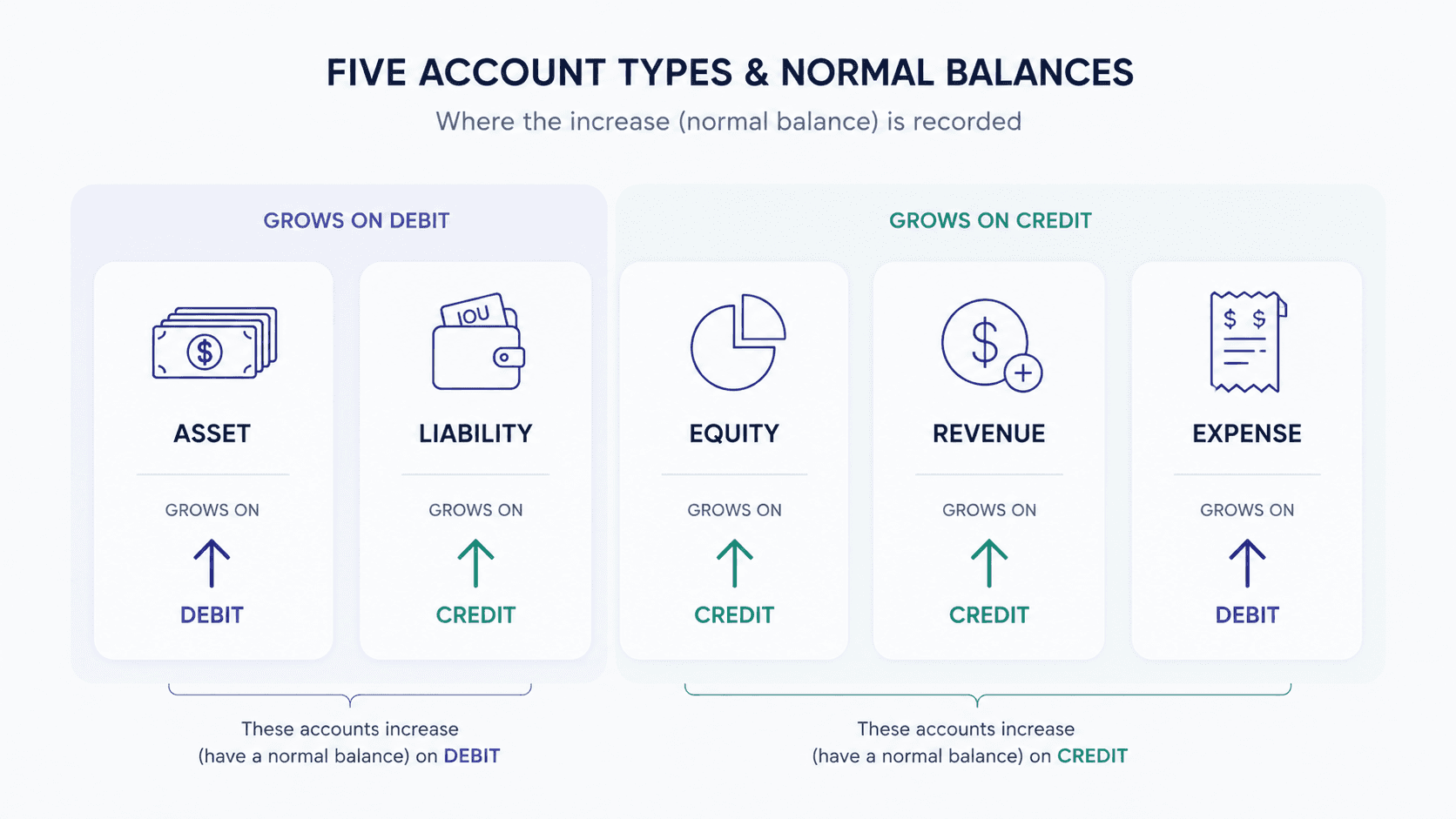
There are five kinds of accounts. Each one has a side it "grows on" (called its normal balance):
| Type | Grows on | Shrinks on | Example |
|---|---|---|---|
| Asset | Debit | Credit | The cash the company holds |
| Liability | Credit | Debit | Money the company owes customers |
| Equity | Credit | Debit | The owners' stake |
| Revenue | Credit | Debit | Fees and interest the company earns |
| Expense | Debit | Credit | Costs the company incurs |
One way to remember it: assets and expenses grow on the debit side; everything else grows on the credit side.
Cheat sheet: screenshot this.
- DEbit-normal (grow on debit): Assets, Expenses
- Credit-normal (grow on credit): Liabilities, Equity, Revenue
- Same-side entry → the account grows. Opposite side → it shrinks.
- Every entry: total debits = total credits. No exceptions.
Another way: debits and credits are just labels. What matters is that the rule "debits = credits" holds for every entry.
Working an example, very slowly
We'll follow one customer, Alice, through three events in a row (a deposit, a withdrawal, and a fee) and watch her wallet balance move after each one. That running balance is the whole point of the page: nobody stores it, it just falls out of summing the entries.
Event 1: Alice deposits GHS 500 into her wallet. There are two accounts involved:
PLATFORM-FLOAT: the company's cash pile. This is an Asset.CLIENT-42: the customer's wallet. This is a Liability (the company owes them 500 now).
Why is a customer's wallet a "liability"? Because the ledger is written from the company's perspective, not the customer's. Money sitting in Alice's wallet is money the company owes back to Alice. A debt it must be able to pay out on demand. Her asset is the company's liability. Get this one reframe and the entire normal-balance table suddenly makes sense.
Here is the journal entry:
| Account | Type | Debit | Credit |
|---|---|---|---|
PLATFORM-FLOAT | Asset | 50000 | |
CLIENT-42 | Liability | 50000 | |
| 50000 | 50000 |
Let's read it out loud:
PLATFORM-FLOATis debited 50000. It's an asset, and assets grow on debits. So the company's cash pile grew by 500.CLIENT-42is credited 50000. It's a liability, and liabilities grow on credits. So what the company owes the customer grew by 500.- Debits equal credits (50000 = 50000). The entry balances. It can be posted.
Both sides make sense. Cash came in; a debt to the customer came into existence. The books are still in balance because both sides grew by the same amount.
Alice's wallet balance after Event 1: 50000 (one credit of 50000, no debits yet).
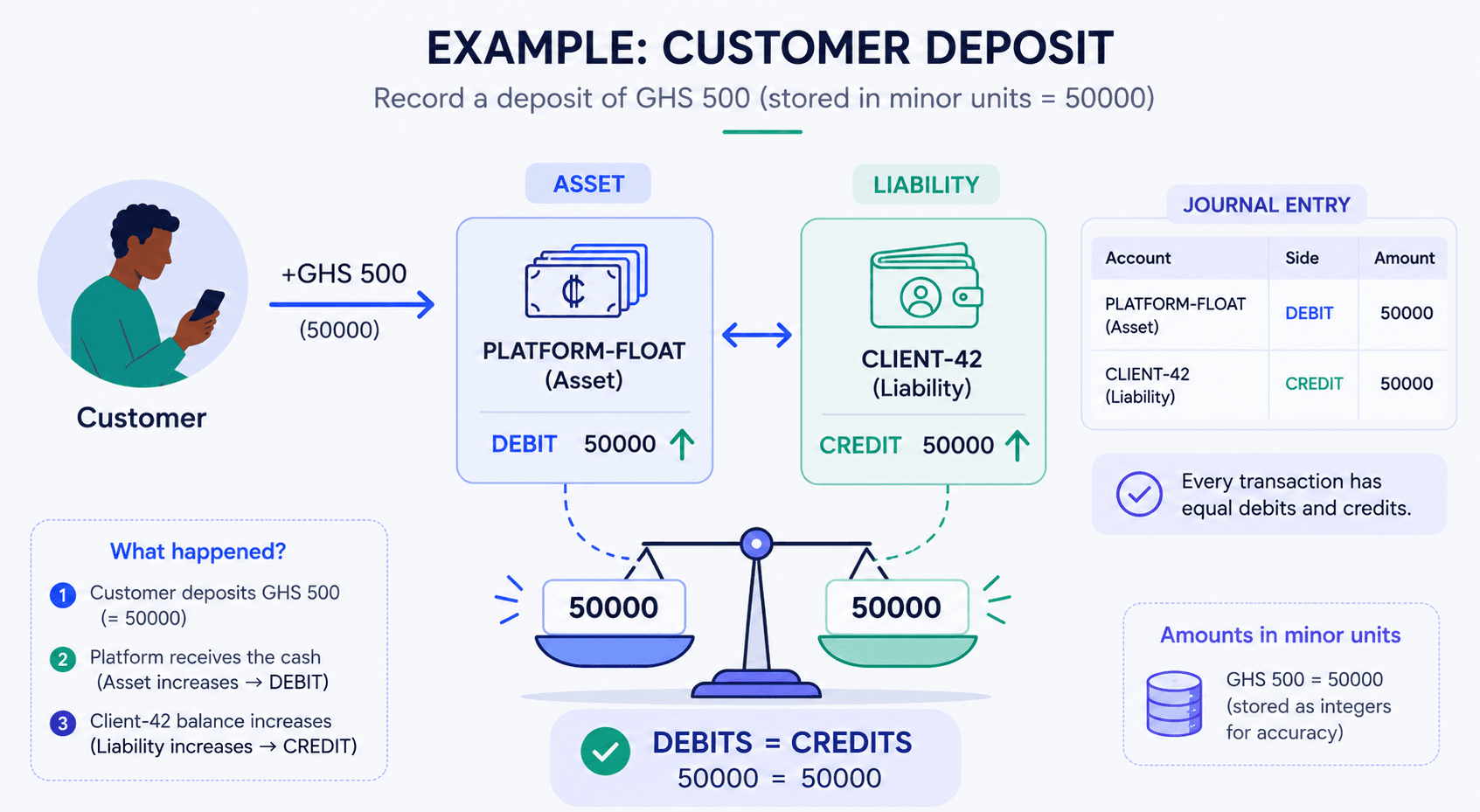
The number 50000 here is not "fifty thousand cedis." It's GHS 500.00
in pesewas: minor units. Everything in Shiwake is minor units,
always. GHS 1.00 is 100, USD 1.00 is 100, JPY 1 is 1.
Event 2: Alice withdraws
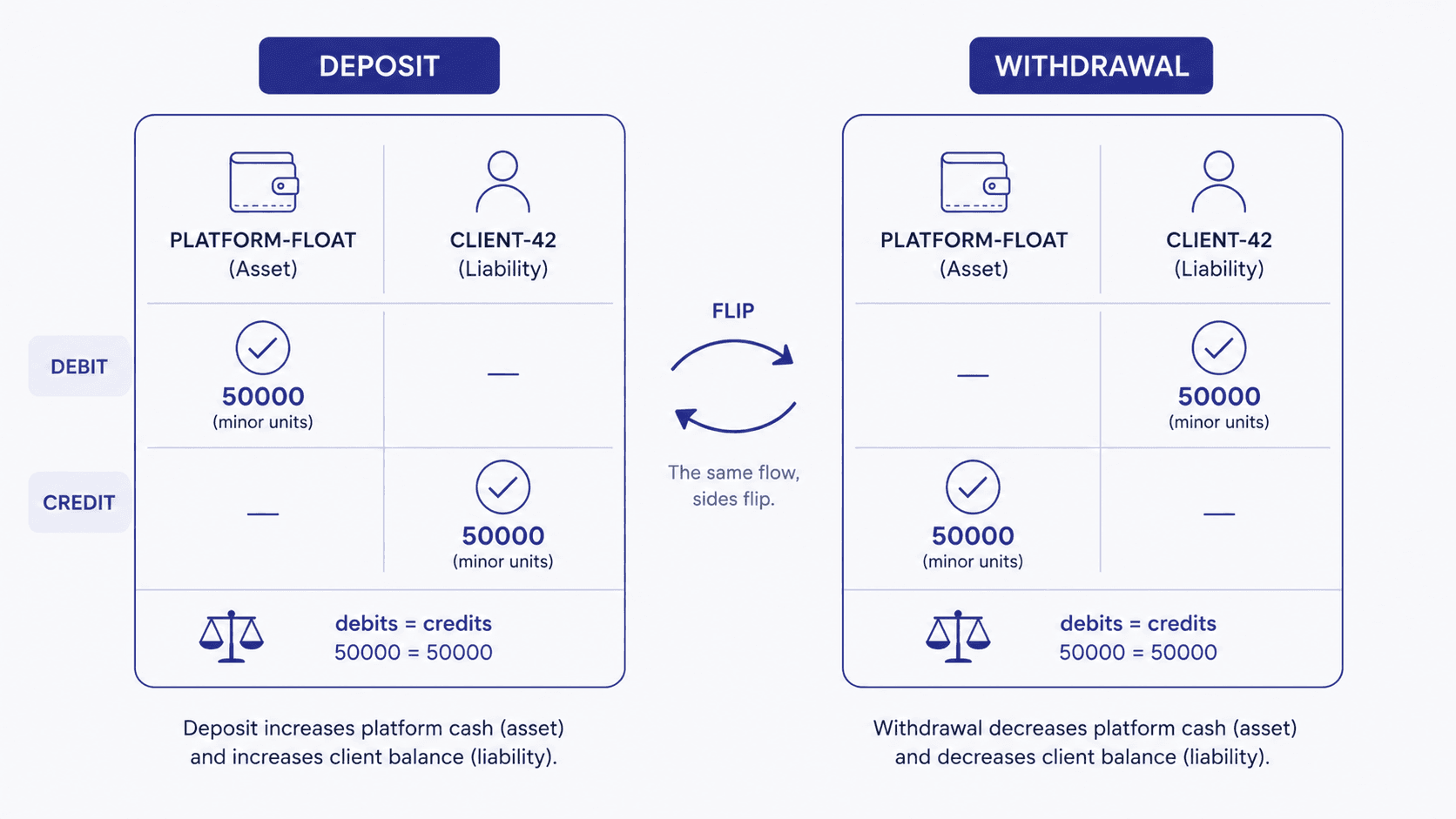
Event 2: Alice withdraws GHS 200. Same two accounts as before, but now both sides shrink:
| Account | Type | Debit | Credit |
|---|---|---|---|
CLIENT-42 | Liability | 20000 | |
PLATFORM-FLOAT | Asset | 20000 | |
| 20000 | 20000 |
CLIENT-42is debited 20000. Liabilities shrink on debits. The company owes the customer 200 less now.PLATFORM-FLOATis credited 20000. Assets shrink on credits. The company's cash pile is 200 smaller.
Alice's wallet balance after Event 2: 30000 (credits 50000 − debits 20000). Nobody wrote "30000" anywhere. It's just the credits minus the debits so far.
Notice how the debit/credit labels flipped sides compared to the deposit. That's the whole point. The same pair of accounts can move in either direction depending on which side you put them on.
Event 3: Alice pays a fee
Event 3: Alice pays a GHS 5 fee out of her wallet. A new account appears. The fee doesn't go back to the float, it becomes the company's revenue:
| Account | Type | Debit | Credit |
|---|---|---|---|
CLIENT-42 | Liability | 500 | |
FEE-REVENUE | Revenue | 500 | |
| 500 | 500 |
CLIENT-42is debited: the customer's wallet shrinks.FEE-REVENUEis credited: the company's revenue grows.
Still balanced. This is a single journal entry with two lines, just like the others. The only thing that changed is which accounts are involved.
Alice's wallet balance after Event 3: 29500 (credits 50000 − debits 20500).
Here's the whole story in one view: three entries, one running balance, never stored anywhere:
| After event | Entry | CLIENT-42 running balance |
|---|---|---|
| Start | 0 | |
| 1. Deposit GHS 500 | credit 50000 | 50000 |
| 2. Withdraw GHS 200 | debit 20000 | 30000 |
| 3. Fee GHS 5 | debit 500 | 29500 |
Sum the credits (50000), subtract the debits (20000 + 500), and you get 29500 every time, no matter what order you replay the log in.
Why "debits = credits" is load-bearing
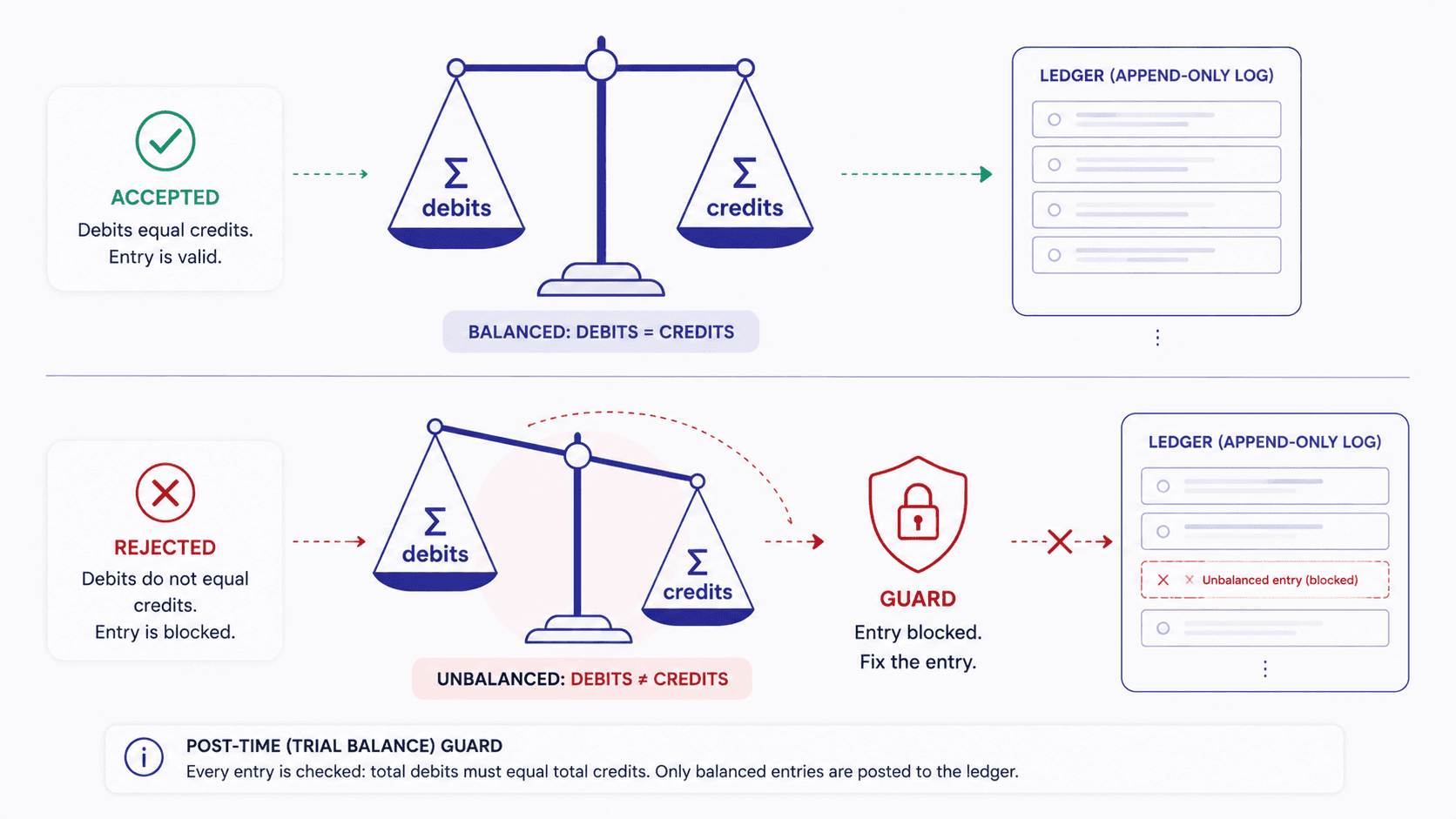
Because every fact in the log balances, the sum of all debits across the whole ledger always equals the sum of all credits. If those two numbers ever disagree, something is broken at a very deep level. The trial balance endpoint computes exactly those two numbers and tells you whether they match.
This is also why Shiwake rejects unbalanced entries at post time. The engine literally cannot let you write a broken fact into the log, because one broken fact would permanently poison the ledger.
Running balances are derived
Notice that nothing in Alice's three events said "store the wallet
balance somewhere." The balance is whatever falls out of summing the log.
CLIENT-42 has a balance of 29500 because its credits sum to 50000 and
its debits sum to 20500. If you ever doubt the balance, you can recompute
it from scratch from the entry lines. That's what
verify-balances does.
Shiwake does cache balances for performance (reading a wallet shouldn't have to sum millions of rows), but the cache is subordinate to the log. The log is the truth.
Reversing, not deleting
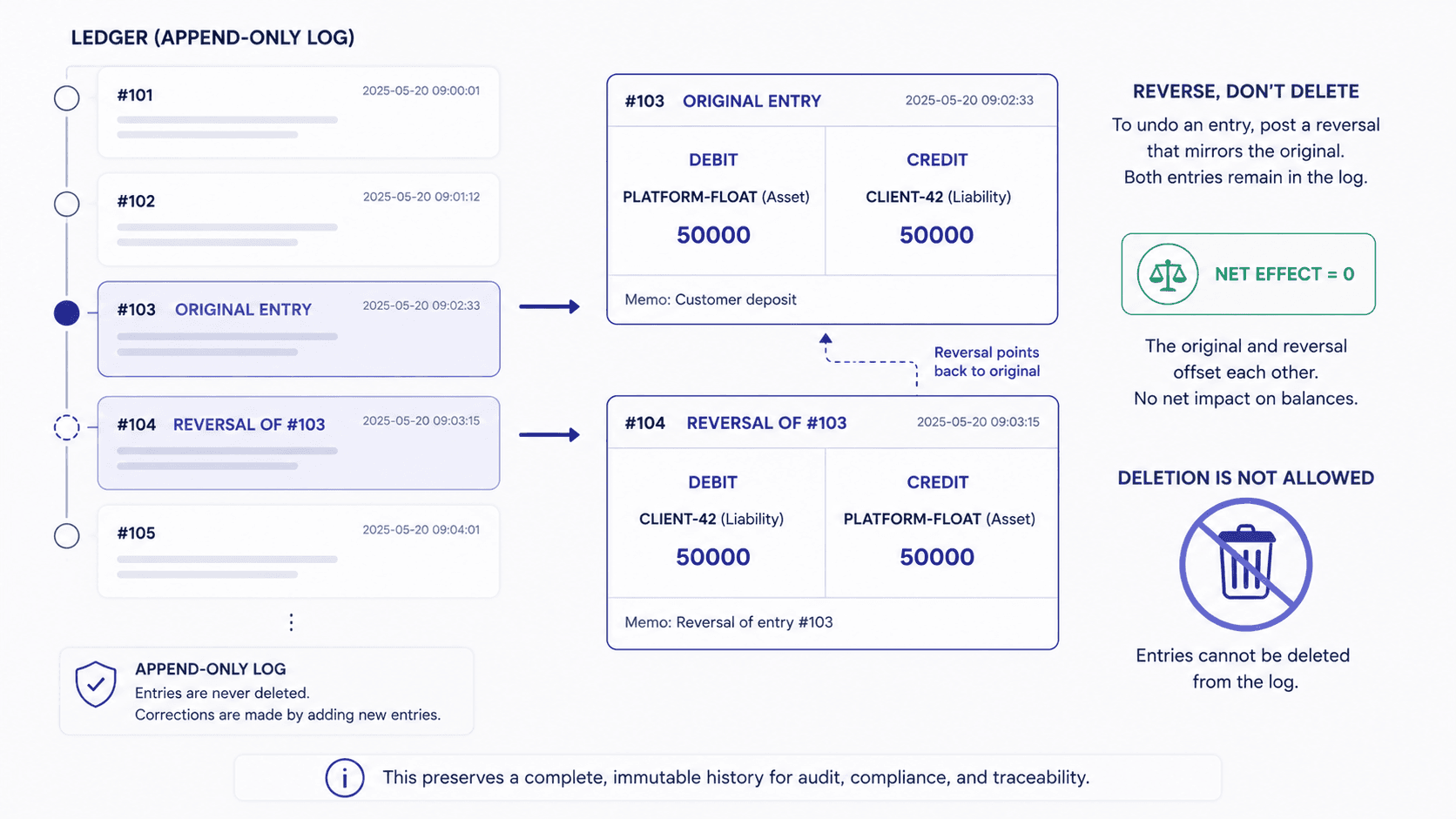
Suppose the deposit was wrong: the customer actually sent GHS 500 to the wrong account and you need to undo it. You do not delete the journal entry. You post a reversal. A new entry with the debits and credits swapped, pointing back at the original:
| Account | Debit | Credit |
|---|---|---|
CLIENT-42 | 50000 | |
PLATFORM-FLOAT | 50000 |
The original entry still exists. The reversal also exists. Both are in the log forever. The net effect on balances is zero, but the history of what actually happened. "we posted a deposit, then we undid it": is preserved. An audit trail that can be edited is not an audit trail.
One more idea: holds
Sometimes you need to reserve money without moving it yet, like an authorization on a card before the final charge lands. That's a hold: it lowers the available balance so the money can't be spent twice, but it posts no journal entry and doesn't touch the actual balance. When the real transaction settles, you release the hold and post a normal entry.
The takeaway for now: a hold is a promise, not a movement. Only journal entries move money. Holds get their own page later. This is just so the word isn't a surprise in the glossary below.
Glossary
| Term | Meaning |
|---|---|
| Ledger | The log of all journal entries. The source of truth |
| Account | A named bucket whose balance is computed from the log |
| Journal entry | A single atomic fact in the log, with ≥2 lines |
| Line | One side of one entry: an account, an amount, and a debit/credit flag |
| Debit / credit | Left side / right side of the ledger. Not "in" and "out" |
| Normal balance | The side (debit or credit) an account type grows on |
| Asset | Something the company owns (cash, receivables). Grows on debit |
| Liability | Something the company owes (wallets, deposits). Grows on credit |
| Equity | Ownership stake. Grows on credit |
| Revenue | Income earned (fees, interest). Grows on credit |
| Expense | Costs incurred. Grows on debit |
| Trial balance | Sum of all debits vs sum of all credits. Must be equal |
| Reversal | A new entry that cancels an earlier one. Never a delete |
| Hold | A reservation against available balance without moving money |
| Minor units | The smallest unit of a currency. 1 cedi = 100 pesewas |
Where to go next
Last updated on